The artists’ perspective
If the independent artist sits at the centre, the story becomes one of dependency migration.
Before streaming, an artist who wanted to reach listeners had to go through a record label. The label decided who got signed and provided the resources and expertise to promote and sell their music. The scarce thing was access to a large audience, and the label was its gatekeeper.
Streaming changed that. Distribution was once hard and expensive. Independent artists can now distribute music to Spotify relatively easily and cheaply through digital distributors. But the need to be noticed did not disappear. Artists can now reach the ‘digital shelf’ more easily, but the shelf is infinite. Visibility became the new scarcity, one that is increasingly controlled by data and algorithms. The question is no longer “can I get my music onto the platform?” but “can I build enough direct audience on the platform?”
Artists and producers started to write and structure songs to satisfy the platform’s curators and data-driven algorithms. So-called ‘Ghost artists’ started to appear on Spotify and other streaming platforms around 2015. Instead of selling a creative idea, ghost artists help sell an "aspirational aesthetic" or lifestyle. The music is reframed from "culture" to "mood," focusing on how the listener wants to be perceived or how they want to feel in the moment. Spotify was even accused of paying musicians to produce music that perfectly fits its playlist guidelines. An extreme form of these adaptations has seen the rise of ‘AI artists’, using automation to produce music.
Other adaptations changed how the music itself was created, including shorter tracks and shorter intros to hook listeners quickly and prevent skipping before Spotify registers it. Artists began to favour frequent releases of single tracks over full album launches to stay fresh in the algorithm's memory. Some started to write to fit the mood of popular playlists.
Here, the feedback is through the catalogue itself. If the algorithm rewards certain kinds of songs, artists make more of them. The catalogue slowly fills with music shaped to the algorithm. Listeners are then offered more of that music. As they stream it, it is recorded as preference and fed back into the algorithm, which rewards the same features even more strongly. The system starts to learn from behaviour it helped to create. The instrument Spotify uses to measure taste begins, gently, to shape the taste it is measuring. If this loop continues over time, it might gradually change the diversity and quality of the catalogue.
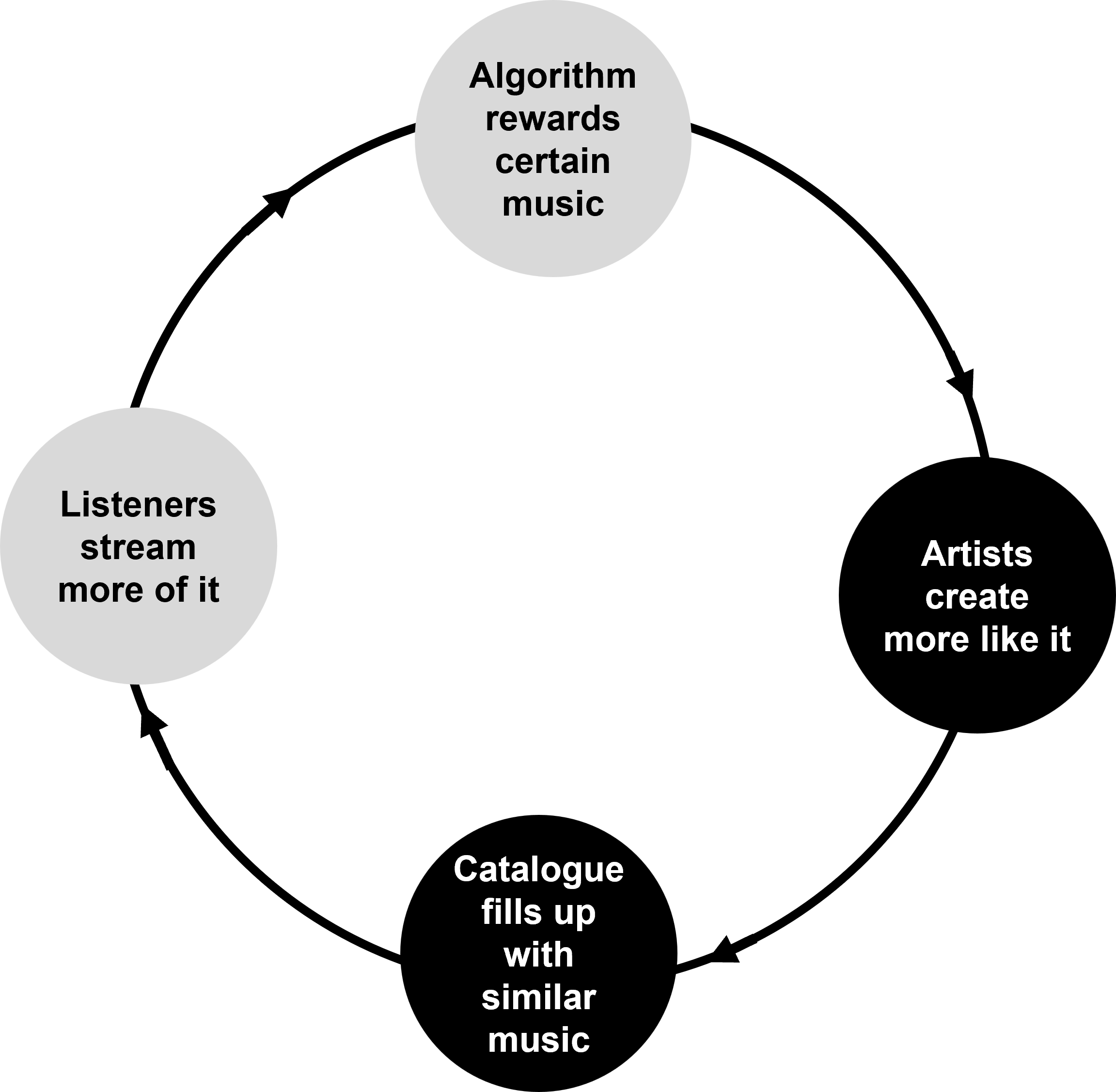
Spotify’s algorithm learns from the behaviour it helped create: When Spotify rewards certain music, artists make more of it, listeners hear more of it, and those streams reinforce the original signal. Over time, the depth and diversity of the catalogue can shift.
There is a counterforce. As the music grows more similar, some listeners feel it, lose trust in what the platform recommends, and go looking elsewhere: to human curators, live music, smaller communities. Engagement can stay high by the numbers while quietly growing shallower, slowly draining away.
For discussion: Spotify’s recommendation advantage depends on knowing what listeners truly want. But if recommendations shape both what listeners hear and what artists create, at what point does driving more engagement begin to reduce the diversity and therefore, the value of the catalogue?